Applied Physics: Projects
LONG-RANGE OCEAN ACOUSTIC SCATTERING

Back in 2009 and 2010 I participated in a major ocean acoustics experiment in the Philippine Sea with APL-UW's North Pacific Acoustic Laboratory (NPAL) group. One of the key topics our research group is interested in is how oceanic sound propagation is affected by internal waves (waves down deep in the water) and by ocean "spice" (blobs of water with a different soundspeed but same density as their surroundings, so they don't behave like waves). Both these phenomena cause variations in soundspeed of the water and thus acoustic transmissions through it, and acousticians would like to understand them better. Our group is also interested in the estimation of ocean sound-speeds and temperatures from receptions of sound that we send through the water. Find out more about our use of these different methodologies in our research on my NPAL Ocean Acoustics page.
RADIO SCIENCE GRAVITY INVERSION FOR ICY MOON INTERNAL STRUCTURE

The nature of an icy satellite's interior relates fundamentally to its composition, thermal structure, formation and evolution history, and prospects for supporting life. Gravity measurements via radio Doppler information during spacecraft flybys are an important tool used to infer gross interior structure of these moons. Liquid water and ice layers have previously been inferred in Jupiter's icy satellites Europa, Ganymede, and Callisto via magnetic field measurements by the Galileo probe. We apply geophysical inverse theory tools to assess the icy moon's interior density anomaly distribution that could be estimated from radio Doppler measurements, to support the search for mass anomalies in the ice shell (meteorites or diapiric upwellings) or near the H2O/rock interface (seamounts).
ELECTROMAGNETIC INVERSION OF ESTUARINE SALINITY STRUCTURE USING SMALL-SCALE CSEM
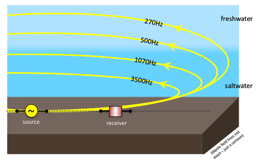
The Conductivity Profiler is an instrument for remotely observing estuarine salinity profiles via electromagnetic measurements. Electromagnetic (EM) waves are attenuated in seawater as a function of frequency, and conductivity structure (closely related to salinity structure) in the water can be inferred by combining measurements of EM waves at different frequencies on a distant electric field receiver. Geophysical inversion methods are applied to estimate the estuarine salinity profile from the EM measurements. Using inverse theory techniques, we take advantage of statistical rigor and let the data determine the structure of the conductivity profile and quantify the uncertainty and resolution of the salinity profile.
GEOACOUSTIC INVERSION

The Navy’s engineering interest in improving sonar performance in shallow waters depends on understanding seafloor properties that interact with the sonar acoustics. This need in turn drives the geophysical science goal of nonlinear inversion for ocean bottom properties at naval sonar frequencies and scales. The geoacoustic inverse problem parallels terrestrial and marine seismic inversion, but at different frequencies and size scales than typically used in seismology and oil exploration work. The aim is to estimate the ocean bottom properties as continuous profiles in depth in the top few hundred meters of the ocean bottom, given full-waveform pressure time series from arrays of hydrophones located in the water column. This work quantifies uncertainty, resolution, and regularization in this full-waveform problem, and uses them to design experiments (array geometry, source range and depth) before any data are collected.
No matching items